
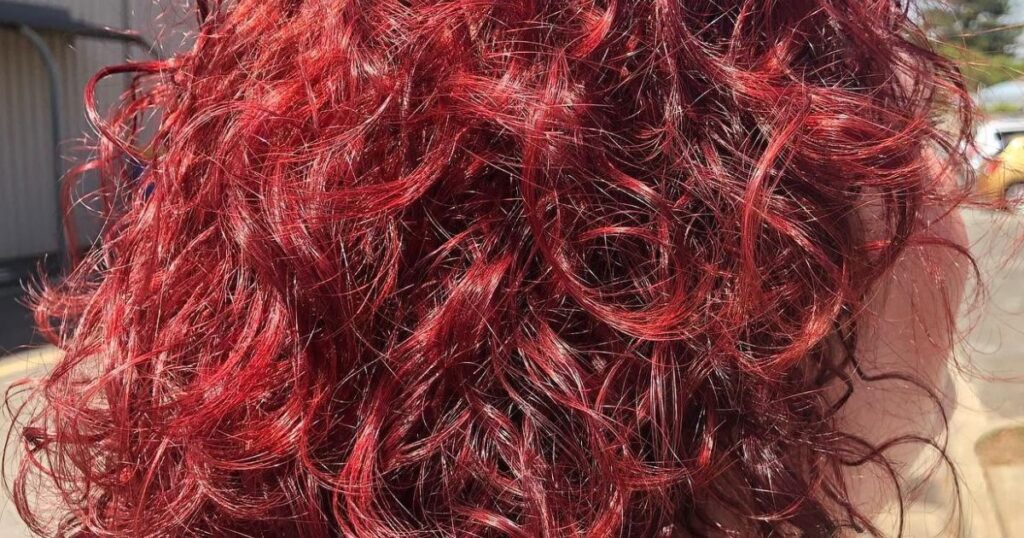
If you have curly hair and you have been disappointed by salon after salon, there is something worth knowing before you write off the possibility of a good result entirely. The problem, in most cases, was not bad luck or bad hairdressers. It was bad training.
For decades, the hairdressing industry taught apprentices to cut curly hair the same way they cut everything else: shampoo it, blow-dry it straight, flat-iron it if necessary, and then cut. The client went home, got their hair wet, and the result never looked right. Of course it did not. The hair had been cut in a completely unnatural state, not at the point on each curl where the scissors actually needed to be.
Most hairdressers were doing exactly what they had been trained to do. The training was simply wrong.
“This is the best haircut I’ve ever had. Ranee knows how to cut curly hair, which is so rare. I’m so happy she didn’t try to straighten my hair like others have done in the past.” — Bonnie
What dry cutting actually involves
Curly hair needs to be cut dry, in its natural state, one curl at a time. That means no comb, no brush, no blow-dryer running in the background. Just the curl, the hairdresser’s fingers, and a pair of scissors positioned at the precise point on that individual curl where the cut needs to happen.
Ranee uses custom curved scissors that can follow the shape of a curl rather than cutting across it. The level of concentration the technique requires is considerable. Her team have been known to catch her on video mid-cut, frowning at a single curl with the kind of focus more commonly associated with surgery than hairdressing.
Once the cut is complete, the hair goes through a full cleanse, hydration treatment, and curl casting process before it is dried. And it is dried fully, which surprises most clients who have spent years avoiding heat because it makes their hair go frizzy. Drying curl properly, with the right technique and the right products, locks moisture into the hair rather than driving it out. The frizz reduction is immediate.
The curls were there all along
One of the most common things Ranee hears from new clients is some version of: “I don’t really have curly hair. I just have a wave.” She hears it regularly, and she is rarely convinced.
Most people with wavy or mildly curly hair have been brushing, combing, and heat-styling in ways that suppress their natural curl pattern over years or even decades. The curl is genetic. It does not disappear. It just gets flattened into something that looks like frizz.
In a single appointment, with a proper curl cut and hydration treatment, clients regularly discover curl they did not know they had. It has been there all along. It simply needed someone who knew how to work with it.
“I have previously been told that I had some curl to my hair but wow, the amount of curl I have now is mind blowing.” — Irene
What this means for you
If you have been disappointed before, the question worth asking is not whether your hair is cuttable, but whether the person cutting it understood what they were doing. A hairdresser who was trained to cut curly hair wet, or who has never learned the dry cutting technique, will produce a result that does not hold, no matter how much skill they bring to everything else they do.
The training package for the hairdressing industry in Australia is only now beginning to catch up. In the meantime, if you want your curly hair cut correctly, the most important thing you can do is find someone who has specifically trained in the dry cutting technique and uses it every day.
That is what we do at Jarnell. If you would like to experience the difference, the first step is a consultation.